Strain Gauge Technician Required

July 16th, 2010

Applied Measurements have a vacancy for a strain gauge technician at their Calleva Park premises.

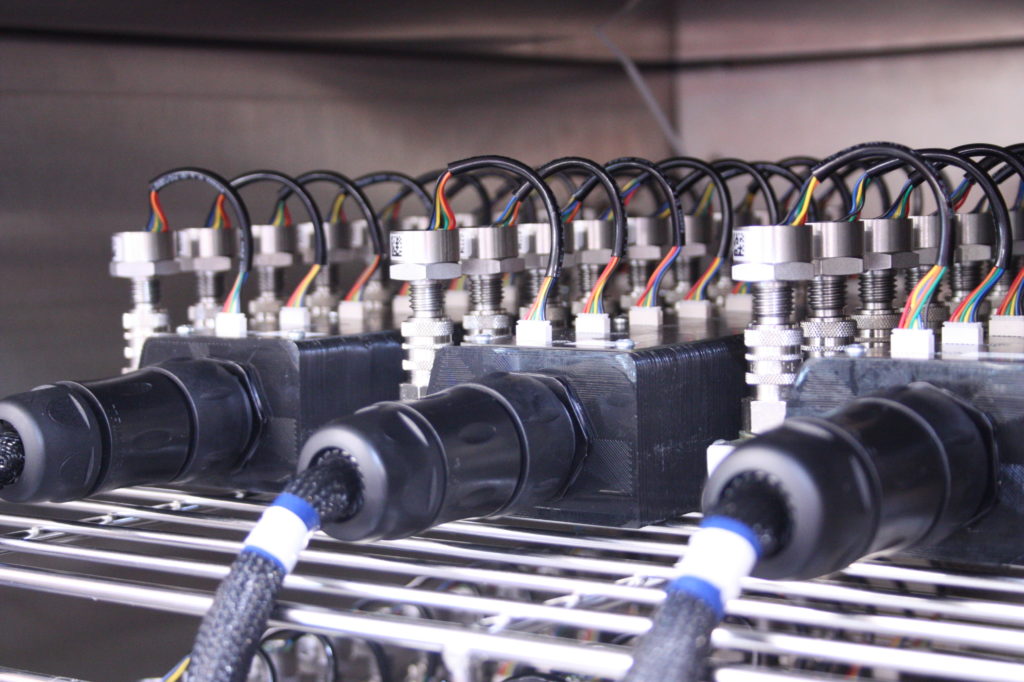
This specialised job involves the bonding of strain gauges to small metal components of many different sizes and shapes. After bonding the strain gauges they are interconnected using fine wire and soldered joints to make an electrical circuit.

The work is very precise and fine detail requiring the use of microscopes for certain parts of the process.  You will require, excellent manual dexterity, to give attention to detail, patient and be of a tidy methodical nature.

Previous experience of soldering, wiring and circuit board assembly would be an advantage, but not essential, as full training will be provided.

This is a full time position working 37.5 hours per week.

Holiday entitlement is 20 days plus bank holidays.

Would suit someone located in the Basingstoke, Tadley or Newbury area.

Salary according to experience.

Please apply in writing to Peter Lewis at Applied Measurements Limited, 3 Mercury House, Calleva Park, Aldermaston, Reading, RG7 8PN or by email to peter@appmeas.co.uk

New Wireless Telemetry Systems For Strain Gauge Sensors

July 16th, 2010

For years the demands placed on higher performance measurement systems have meant they are often less versatile than their predecessor. More sensors means more data is acquired over an increasing number of measurement channels and with these advances has come corresponding concerns regarding cable integrity and management.

This places emphasis on the test technician who is well used to swapping between sensors and matching them with the cable of the right length and appropriate connector. Running cables across floors or through sensitive areas is at best inconvenient; with high performance cable products subject to mechanical damage throughout routine use.  Considered the weak link of many a measurement system, they are often the first focus of attention whenever measurement errors do occur.

For the best possible quality of signal, to avoid cable losses and measurement errors the strain gauge conditioning unit should be positioned as close to the measurement as possible.  However in large buildings or structures, or where many channels of measurement are required, this is often not convenient.

However a solution to these issues is only that if it solves these problems without slowing or degrading the existing flow of information, or reducing the ability to create new channels for data acquisition.

Applied Measurements Ltd has launched the T24 radio telemetry system to connect to any strain gauge based sensor for the measurement of load, pressure, torque and displacement as well as standard 0-10V & 4-20mA sensors.  This means customers are now able to connect wirelessly using low power radio techniques, which allows data to be collected over many channels simultaneously. The acquisition module uses a secure transmission network and provides live data over distances of up to 120m line-of-site and even further using external antennas.

The range of products include:

  • T24-xA  -  Acquisition Modules  -  Voltage / Current / millivolt input
  • T24-RM  -  Relay Output Module  -  for limit or relay alarms
  • T24-HS  -  Handheld Displays  -  for configuration, taring, summing etc
  • T24-PR1  –   Printer Module  -  wireless thermal printer
  • T24-AO1  -  Analogue Output  -  4-20mA / 0-10Vdc / ±5Vdc
  • T24-BSu  -  USB Base Station  -  for data collection and configuration

The T24 Wireless Telemetry Range

Each acquisition module can be used to supply data to several different output devices, or receive data from a multiple of acquisition modules.  This inbuilt flexibility avoids dedicated components and means uses do not need to stock application specific modules.

The data acquisition PCB’s have been miniaturised sufficiently, so that they can be mounted directly within the sensors themselves.  This means if need be, the signal can be transmitted directly form the sensor (load cell, pressure transducer etc) with no external cabling.

Some examples of wireless applications include the following (more information can be supplied on any of the examples given):

  • Automotive – Torque Measurement
  • Civil Engineering – Monitoring of Anchor Loads
  • Construction – Monitoring of Building Foundations
  • Lifting & Handling – Crane Load Pins
  • Marine – Mooring Ropes
  • Silo & Weighing Industry – Silo Weighing
  • Theatre & Outside Events – Stage & Rigging Monitoring
  • Waste Management – Skip Weighing
  • Alternative Energy – Wind Turbines

Approved for use by the FCC, ETSI and Industry Canada amongst others, the T24 system is based on a proprietary 804.15.4 chip and the range of wireless products co-exists with Bluetooth, Zigbee & WiFi devices without conflicts.  The 2.4GHz band on which it operates is license free around the World and importantly, data being transmitted is secure as each of the radio modules use a unique 6-digit Hexadecimal key and interference is avoided through the use of a proprietary protocol.

To set up the measurement a software toolkit is supplied as a free of charge downloadable file (Freeware).  This provides the user with the means to view and alter the device parameters and perform the calibration of all the modules wirelessly.  Additionally, radio link quality and sensor integrity can be checked, configurations can be stored, data can be logged to a CSV file and PC based reports can be prepared.

T24 data viewer and logger screenshot

T24 Data Viewer & Logger Screenshot

Some of the features / benefits derived of the system include:

  • No costly purchase of cables or the associated inconvenience
    of identification, storage and maintenance.
  • Eliminates measurement errors due to cable failure or connection problems.
  • Wireless is particularly suitable for some rotating or precision applications.
  • A wireless link can cost less than buying and installing a cable.
  • The acquisition modules are designed to sleep / wake to preserve battery life.
  • Existing PC terminals are used to log data from acquisition modules on site,
    so no additional hardware is required.
  • Once time stamped the data collected is forwarded to your server,
    desktop or mobile device in real time.

The benefits of this new product have been realised by one recent new customer as manroland Ireland’s Managing Director Martin Lockley says, “the fact that there are no wires and that the units are battery driven, makes this equipment very easy to deploy.  The load cell is being used to measure the clamping force in an area that is protected by light curtains and as such a wired system would not have been safe or practical to use in this environment.”

The wide-ranging potential for wireless signal transmission means that it is perfectly possible that in the not too distant future, measurements incorporating cables are limited to task specific applications.

The strength of the argument to go wireless in many applications is overwhelming. Having first hand knowledge of the problems associated with some cabling requirements, the demand on wireless systems is bound to increase still further and Applied Measurements will be well placed to take advantage of the solution.

If you require any help in the selection of the appropriate T24modules, our engineering staff will guide you through the process of matching the appropriate modules and getting the most out of wireless.

View the full T24 Wireless Telemetry range here

You can contact our sales engineers on +44 (0) 1189 817339 or by email: info@appmeas.co.uk

Sensors: Accuracy and Resolution Explained

April 22nd, 2010

When it comes to sensors and transducers, accuracy and resolution are two terms that are often a source of confusion so here is a helpful article to clear everything up.

We will use a set of digital kitchen scales as the reference for our explanations:

  • They have a rated capacity of 10kg (10,000 grams)
  • They have a digital display that reads from 0.000kg to 10.000kg in steps of 0.001kg
  • Their accuracy is better than ±0.1% of their rated capacity

Resolution

Resolution is the number of pieces or parts that the output or displayed freading from a sensor or measuring instrument can be broken down into without any instability in the signal or reading.  It can be expressed in a number of ways, the two most common being:

1. Decimal Places

Our 10kg kitchen scale has a resolution of kilograms to 3 decimal places or ’3dp’.  This expression is made relative to the engineering units in which the scale is set to read.  Alternatively, if the kitchen scale was set to read from 0 grams to 10,000 grams in 1 gram increments it would be described as having a resolution of grams to zero decimal places.

2. Parts/Divisions/Counts

Our 10kg kitchen scale has a resolution of ’1 part in 10,000′, ’10,000 divisions’ or ’10,000 ‘counts’.  This expression describes resolution in absolute terms, rather than referring to an engineering unit.


Accuracy

Accuracy tells you how how closely the output or displayed reading from a sensor or measuring instrument will match the ‘true’ value.  Any mismatch between the reading and the ‘true’ value is usually referred to as the ‘error’.

In the case of our kitchen scale, this figure is <±0.1% of 10kg, which means that its reading will match the applied weight to ±0.010kg (±10 grams) or less, for instance:

  • With exactly 4.000kg of weight applied to the scales the display reads 3.990kg.  This is an error of 0.010kg or 0.1% of rated capacity.
  • With exactly 5.000kg of weight applied to the scales, the display reads 5.004kg.  This is an error of 0.004kg or 0.04% of rated capacity.

Practical Limitations

It is important to have the correct balance between accuracy and resolution to ensure that neither parameter is compromised.  In our example we have an accuracy of 10 grams and a resolution of 1 gram, this is a good balance.

The resolution of 1 gram ensures that the accuracy of 10 grams can be resolved without creating a false impression of accuracy.  For example, if the resolution was increased to 0.1 grams it tends to give users the impression that they have greater accuracy.  This increased resolution can also cause undesirable display instability.

If you would like any further information please feel free to contact us by telephone on +44 (0) 1189 817339 or email: info@appmeas.co.uk

High Accuracy Displacement Sensors Use Strain Gauge Technology

April 14th, 2010

AML/SGD-100mm Strain Gauge Displacement TransducerAs a result of increased demand from customers preferring to use a strain gauge based measuring system, we have introduced a 0–100mm version to our range of displacement transducers.

Based on a four-arm Wheatstone-Bridge design with a nominal impedance of 350 Ohms, the design ensures excellent non-linearity, low power consumption and excellent temperature stability.  Additionally, the characteristics of strain gauge based sensors provide higher accuracy linear sensing than that of less accurate and lower resolution LVDT sensors.

These advantages have been realised by Oxfordshire based company Fugro GeoConsulting Limited, who use the existing 0-50mm version of the sensors within their accredited geotechnical soil-testing laboratory.  This high-tech establishment tests soil samples in order to predict how they will behave when subject to the stresses and loads that planned new buildings will place on them. The lab has worked on many major projects including some of the world’s tallest buildings, biggest bridges and countless oil & gas rigs and wind turbine sites. The loads being simulated in the lab include the varying effects of wind, wave, tide and earthquake action, as well as the dead weight of the building itself.  The sensors are used (together with submersible load cells, also from Applied Measurements) to accurately monitor small changes in the dimensions of the samples as tests progress.

Fugro’s Laboratory Manager, Roger Brown, said “We test soil samples from all over the world and considerable time and effort is spent retrieving them from varied and often challenging locations, for example from the seabed at deep water locations in the Atlantic Ocean and as such, each sample is unique and expensive to collect.  In addition, some tests can take several weeks to perform.  The lab gets one shot only at each test and hence we need confidence in the testing equipment so that the results can be relied upon”.  Because these sensors operate at similar voltage levels and produce output signals compatible with other commonly used strain gauge sensors such as load cells and pressure transducers, they can easily form part of the same measurement chain in one central instrumentation system.

These displacement sensors operate on low cost DC strain indicators or digital voltmeters, whereas standard LVDT transducers require conversion of the signals to achieve the same level of compatibility.  The simplicity of this type of measurement requiring no further processing of the basic signal, can make this type of test or measurement significantly more attractive to a user.

Additionally, strain gauge based displacement transducers exhibit typical non-linearity errors of a quarter of that of typical LVDT’s.  As with other strain gauge devices, the resolution is infinite and strain sensitivity is constant with a stabilized input voltage between 1.5Vdc and 15Vdc.

The range of AML-SGD displacement sensors are precision assemblies contained within a rugged stainless steel outer casing. The internal construction of the AML/SGD transducer ensures a smooth, virtually frictionless movement of the inner core, resulting in high overall accuracy of <±0.1% on 0-5mm, 0-10mm and 0-25mm models, <±0.15% on the 0-50mm model and <±0.25% on the 0-100mm model.

The return force of the spindle is maintained at a minimum level for effective operation when installed upside-down, without having to attach the spindle to the subject.  This makes the sensor less intrusive to the application when measuring on soft or pliable materials.  The sensors are designed for long life and excellent mechanical reliability, hence the 3-year manufacturing warranty offered.  This is evidenced by existing applications where these transducers have passed 14 million cycles in normal operation.  And unlike some LVDT transducers, the AML/SGD product is completely serviceable by the manufacturer in the event of damage in use.

Any transducer device would be quite useless without means of providing appropriate supply voltage and output signal and this is often a significant part of any data acquisition programme.  The AML/SGD range of displacement sensors ensure these costs remain at a minimum, by utilising strain gauge signal inputs of existing data acquisition equipment.  In this way, these displacement sensors limit expenditure to the cost of the sensor only, thus eliminating further capital outlay on dedicated instrumentation.

However these advantages would be of no use if this combination of user benefits meant extended lead times.  As such it is the policy of Applied Measurements to keep most standard ranges in stock, meaning that the payback period is shorter and the benefits can be realised sooner.

Compact, rugged and easy-to-install, AML/SGD displacement sensors are used by industries such as R&D, machine builders, automotive, marine and geotechnical.  The total cost of ownership of instrumentation is now more relevant than ever for these industries and improvements in the versatility of sensors that allow their use with simple DC signal conditioning is but one method of spreading the life costs.

For more information on the range of AML/SGD range of displacement transducers please see the AML/SGD Product Page or PDF Datasheet.  Alternatively, please call us 0118 981 7339 or send an email to: info@appmeas.co.uk

Bolt-On Weighing Systems

March 29th, 2010

BOSS-F bolt-on load cell installed on a silo legFitting a weighing system to an existing silo, hopper or tank using a conventional load cell system can be expensive, disruptive and sometimes even impossible.  UK sensor experts Applied Measurements Ltd offer a solution to these problems by using a simple bolt-on load transducer.

This weighing approach is cost effective and quick to install, causes a minimum of production down time and is ideal as a retrofitted system. The BOSS bolt-on sensor is a well-proven robust product consisting of a strain-gauged element encased in a protective housing.  It is simply bolted to a structural member of the silo and deflects under the changing weight conditions, to give a varying electrical output relative to the load.

Bob Davies, general manager at Applied Measurements comments “with more than 25 years experience of bolt-on sensors, we assess the suitability of this method of measurement for each individual enquiry, including an on-site survey if required. This ensures the feasibility of a successful installation at the outset and we will commit to the accuracy likely to be achievable”.  The very first consideration is the available stress for the sensor to measure and this is broadly dependent on the load applied and the design of the supporting structure it is mounted on.

Bolt-on systems are more than adequate for the majority of vessel weighing or level monitoring systems, where accuracy in the order of 1% – 2% is acceptable.  We bolt the standard transducers to a suitable supporting member such as a leg, girder, channel or pipe.  However in some applications custom profiled mounting blocks may be required to suit the profile of the supporting steelwork.

For a system to be viable the load to be measured should be between 3000psi and 10,000psi.  The accuracy achieved depends on a number of factors, but most significantly the amount of available strain to be measured.

Each BOSS sensor has an average sensitivity of 1.7mV/V for 10,000PSI.

As a general rule, sensors mounted internally will give the best results. With external systems there will often be a margin of error due to zero shift, which is a result of differential expansion due to solar radiation but even this can be nullified to an extent.  The accuracy achieved will be very dependent on the positioning of the sensor on the steelwork.

Accuracy Bands

  • 3,000 – 5,000     PSI     gives +/- 2 to 3% or better
  • 5,000 – 7,500     PSI     gives +/- 1 to 2% or better
  • 7,500 – 10,000   PSI     gives +/- 1%

Typical Application

A 220T cement silo on a 6-leg pipe section frame, giving 6000PSI total available signal.  Our customer required best accuracy for batching to supply ships and road tankers. As the available signal was good but not exceptional, we suggested 2x BOSS bolt-on sensors per leg to minimise errors and maximise accuracy.  The result is that the customer can batch to ships +/- 1Tonne in 100T and +/-0.5Tonne in 30T.  To minimise the effect of temperature, each Bolt-on sensor is fully insulated after installation

Suitable instrumentation to accompany the bolt-on sensors includes: mains or battery-operated digital displays, local amplifiers allowing the signals to be monitored in a control room or a telemetry system for wireless monitoring via a remote hand-held receiver or a control room PC system.

For more information on the range of BOSS sensors please visit our bolt-on load cells page, or call us on 0118 981 7339 or email: info@appmeas.co.uk

LowStir Friction Stir Welding System

March 11th, 2010

Friction stir welding is a welding process invented by TWI in 1991.  The process involves a spinning tool, in contact with the material to be welded, with sufficient down force to create frictional heat in the material (about 80% of the material’s melting point).  This causes the material to become soft, allowing the spinning tool to create the weld.

Friction stir welding is now widely used in the aerospace, automotive, rail and ship building industries.

Unlike other friction stir welders, the LowStir friction stir welding LowStir Welding Unit In Action - Image 1system includes a unit that attaches to most standard milling machines via an ISO taper, making it an affordable option to smaller enterprises.  It is supplied with software to calibrate the system, monitor the welding process and log welding parameters for later analysis.

The current LowStir base system comprises the necessary hardware and software to convert a suitable milling machine to a LowStir stir-welding system including an ISO taper (or equivalent) to fit it to the milling machine.  Since this depends on the particular machine, the size and type of taper must be specified when requesting a quotation (as costs of tapers can vary).

Benefits of Friction Stir Welding

  • Improved weld properties (e.g. strength, fatigue) compared to arc welding or riveting.  Joint efficiencies of 75-96% have been reported depending on materials.
  • Because it is a solid phase process (where the materials are joined without melting) no shielding gases or filler materials are required. Furthermore, there is almost complete elimination of weld distortion and solidification defects.
  • Operators do not need special qualifications or certification.
  • There’s no arc welding, gas emissions or weld spatter involved.
  • Vastly reduced preparation and reworking time reduces costs, time and labour requirements.
  • Low power consumption; The only energy required is to rotate the tool and apply force to it to create the frictional heat.  Without the large current requirements of arc welding, energy consumption can be reduced by 80% plus.

The LowStir System

Specifically, the basic components of the system are as follows:

1) LowStir Mk.2 sensor head unit including tool holder and heat shield disc.  This is supplied already bolted together as a complete system including the ISO taper, ready for installation in the milling machine head.

The LowStir unit is capable of measuring:

  • Down force (Fz) to 50kN
  • Lateral force (Fxy) to 25kN
  • Torque (Mz) to 100Nm
  • Temperature of the welding tool via an internal thermistor

The unit will run at rotation speeds of up to 3000rpm and log data at software selectable rates from 1Hz to 100 Hz.

2) Inbuilt battery.  When fully charged, the LowStir unit’s inbuilt battery has a battery life of approximately 10 hours.  The unit is supplied with a battery charger, which can recharge this battery from the mains.  The charger automatically deactivates when the charge is full, so the unit can be safely left to recharge overnight.

3) Jack plug switch.  The unit is also supplied with a jack plug switch which can be inserted to completely disable the unit and store any remaining charge.

4) Set of tool assemblies.  A typical assembly comprises a low wear shank and a replaceable tool (probe).  If you order one tool type there will be one shank and ten probes supplied.  If you order two different types of tool then there will be two shanks (one for each material to be welded) and five probes supplied for each of the two shanks.

5) Taper.  As mentioned above, the system includes an ISO taper or equivalent specific to the milling machine to which the LowStir is to be attached.  The size and type of taper required must be detailed in advance, and ordering the incorrect taper will make it impossible to fit the LowStir unit.

6) Software for monitoring and recording various parameters of the weld.  Note that the software is supplied uninstalled and uncalibrated.  We strongly recommend the optional laptop package, as this is supplied with the software and Bluetooth connection fully set-up and calibrated.  See Optional Extras below for more details.

Optional ExtrasLowStir Welding Unit In Action - Image 2

The following are optional extras that can be supplied at extra cost.  Please specify any extras required when requesting a quotation.

1) Internal temperature probe.  The system can be supplied with an internal probe which is used to monitor the temperature of the weld pool via a probe fitted to the inside of the welding tool holder.

2) Laptop. The software can be provided ready installed on a laptop computer.  In addition, the software will be calibrated for the specific LowStir unit, and the Bluetooth connections established between the laptop and the unit.  It is strongly recommended that this option is taken, as it means that the system is ‘plug and play’ and removes the need to calibrate the system on-site.

Licence

Please Note: Currently you will need a licence from TWI to carry out friction stir welding.  This applies to ALL forms of friction stir welding, including using LowStir.  Please contact TWI or David Johnson at Applied Measurements Ltd for more information.

Custom Torque Sensors Now Available on Standard Lead Times

July 1st, 2009

dtd-s-200x200

A UK manufacturer of torque sensors is offering custom designed static/reaction torque transducers on similar lead times to its standard units, with only a small premium on the standard list price.

Applied Measurements Ltd, based in Aldermaston, is able to design and manufacture custom static torque sensors to meet any customer requirement, including different flange diameters, unusual sizes of square drive, special sealed versions and shorter, more compact designs.

According to Peter Lewis, Managing Director at Applied Measurements: “Many manufactured products require fatigue testing to ensure that they can operate for a guaranteed minimum period of time.  An accelerated life test, for example, may be carried out on a drive shaft to determine the torque limits.  The fatigue testing can sometimes be an afterthought. If this is the case, some kind of customised sensor is then required before the torque sensor can be coupled to the test unit.  This is what Applied Measurements specialises in.”

Whilst Lewis concedes that there are plenty of companies able and willing to supply static (reaction) torque sensors from their standard range, many do not offer customised designs, let alone on lead times that are similar to standard product.

Applied Measurements manufactures two types of static torque sensor as standard, a square drive mounting type and a flange mounted unit.  The DTD-S square drive mounting sensor is designed specifically for measuring direct torque and is ideal for use in the calibration or testing of torque tools (screwdrivers, spanners, etc) in a quality assurance and inspection environments.  The sensor is constructed from stainless steel and is protected to IP65.  For fast, easy connection, the sensor is supplied with an integral, robust bayonet lock military connector.  The DTD-S is available from 10Nm up to 50,000Nm as standard, with custom versions rated to 200,000Nm.

dtd-f-200x2001The DTD-F range of flange mounting static torque sensors are also designed to measure direct torque, but are ideally suited to fatigue test applications.  Again, the units are finished in stainless steel and are protected to IP65.  The sensor is provided with an integral, robust bayonet ‘lemo’ connector for fast, easy connection.

As Lewis continues: “The flange mounting sensors are normally used in applications where there are two mating faces, one driving or applying the torque and the other resisting the torque.  For any torque sensor to work, there has to be a reaction or load to generate the resistance to motion and hence torque.”

“While we offer customers a range of standard torque sensors, we also have the ability to design and manufacture custom versions, where the standard unit does not suit the application. It could be the size and shape of the sensor that needs changing, but could also include the need for odd size ranges that fall between the standard increments.”

Lewis says this could include making the sensor longer, shorter, broader, or with different flange diameters and thicknesses.  Units with different hole spacing or with an odd size of square drive may be requested.  As an alternative to the square drive unit, Applied has also custom designed round shaft units with keyways.  By creating a tubular design and applying the gauges internally, it is possible to create high integrity sealed units for wet environments.  Other designs have included two-axis measurement of combined force and torque, pressure-compensated models or complete submersion units.

Applied Measurements has supplied custom static torque sensors to a variety of customers and industry sectors, including aerospace, marine, oil and gas, robotics, machine building and plastic moulding machines.

Applied Measurements’ full range of static torque sensors can be seen here.  Alternatively, please call the sales department on 0118 981 7339 or email: info@appmeas.co.uk.

Custom Load, Pressure, Torque and Displacement Sensors for Machine Builders

May 1st, 2009

By providing custom design services for its range of load cells, torque sensors, pressure transducers and displacement sensors, Applied Measurements Limited is helping machine builders and systems integrators to reduce lead times, cut costs and improve quality.

“Despite the current economic downturn, we have grown our sales revenues by more than 30 per cent over the last three years,” says Peter Lewis, Managing Director at Applied Measurements Limited. “A major part of this growth is coming from our custom design service for our products, which include load cells, torque sensors, displacement sensors and pressure transducers. We are supplying one-off designs, pre-production prototypes, high volume specials, direct competitor equivalents, as well as modifying or strain gauging existing components.”

According to Lewis, many of Applied Measurements’ global customers now request custom designs on as fast a lead time as possible. “Rather than trying to make existing, standard catalogue sensors ‘fit’ their application, customers now seem to want custom solutions delivered in as short a time frame as possible. After all, there seems little point in offering a custom design service for your sensor if the lead time doubles as a result. Customers simply won’t wait that long. In most cases, we can deliver a custom solution – including concept design, engineering, production and calibration if required – in just six to eight weeks from customer order.”

In a tough economic climate, says Lewis, Applied Measurements has recognised that this ability to meet a customer’s exact design requirements on a competitive lead time, has given the company a clear edge on its competitors.

”Our design service not only includes the ability to design new custom sensors,” says Lewis, “but also includes manufacturing direct equivalents to existing competitor products, as well as retrofit versions that the competitor may have ceased to produce. It can also include the bonding of strain gauges to metal structures or housings provided by the customer and then completing these into a finished, certified and tested product.”

Machine builders and systems integrators often need to upgrade a machine for the end user, to include new electronics or instrumentation, from older mechanical gauges or dials. As Lewis states: “In this age of accountability, it is important to have sensors that are connected to the appropriate instrumentation, including PCs that log and record the measurement data, providing traceability for the end user. In these types of applications, there are usually physical restrictions that also need to be overcome, as the customer is likely to want minimal disruption to the original machine. This is where our ability to fit in with the existing design is a big advantage to the customer. Our combination of mechanical and electronics design capability also helps here.”

Many machine builders need their systems to measure in more than one axis at a time. For this, Applied can design two or three-axis force sensors, with a variation on this when customers want a sensor to combine two measurements, such as force and torque, or force and acceleration.

The aim of the custom design service is to provide customers with a solution that exactly fits their measurement requirements under the constraints of cost, size, environmental conditions, general performance specification and availability. As Lewis puts it: “An incorrectly chosen transducer to fulfill a particular measurement application costs considerable time and money if it is eventually discovered that the data being collected is meaningless, or that the transducer is performing incorrectly due to overloading or poor installation.”

“Our experienced application engineers will talk through the measurement requirements with the customer in order to determine the most appropriate solution. This typically includes discussions on the measurement range required; dynamic transient effects; space restrictions; accuracy levels; and whether there are any unusual environmental conditions to consider.”

For more information on Applied Measurements’ custom engineered solutions please contact our sales department on 0118 981 7339 or send an e-mail to info@appmeas.co.uk.

New Range of Strain Gauge Based Displacement Transducers

April 15th, 2009

AML/SGD Strain Gauge Displacement TransducerApplied Measurements is pleased to announce the introduction of a new range of strain gauge based displacement transducers, the AML/SGD Series.

It is now available with stroke lengths of 0-5mm, 0-10mm, 0-25mm and 0-50mm.  The accuracy offered is +/-0.1% up to 25mm and +/-0.15% above 25mm, plus excellent long term and thermal stability.  They require a stabilised dc voltage excitation anywhere between 2 and 10 volts and return a high level millivolt signal proportional to the position of the plunger.

The AML/SGD Series are constructed using a rugged stainless steel tubular housing containing a spindle guide bearing and spring return mechanism.  A light spring force ensures a minimal effect on the application and enables inverted operation when required.  Precision construction guarantees a long service life with superb mechanical reliability.

The AML/SGD Series are suitable for a broad range of applications in Research and Development, Industrial, Aerospace, Civil Engineering and Automotive.  Being strain gauge based they are compatible with a wide range of analogue and digital monitoring, control and acquisition equipment found in both laboratory and field environments.

Load Cell Allows Tension or Compression Measurement Underwater

March 15th, 2007

dden-200x200When approached by one of our customers to design a load cell for underwater tension measurement, We looked at our core range of products and decided the DDE style load cell, which features M12x1.75 male threads at each end, would best meet the customer’s requirement, but this model as standard is only rated to IP65.

With a small, quick and cost effective re-design we changed the construction to Stainless Steel with two halves locking together with a seal.  Internally it was further protected by back-filling with an inert waterproof gel.  The electrical termination is a tough IP68 multicore cable that is connected through an IP68 cable gland, to complete fully submersible sealing.

The new product has been designated as the DDEN series.

By modifying an existing product we were able to keep the cost and delivery time down to suit our customers needs, whilst displaying our capability to modify or design a product quickly and efficiently.

Click here to view the DDEN Submersible Load Cell product page.