Archive for the ‘Level & Depth Sensors’ Category

Custom Load, Pressure, Torque and Displacement Sensors for Machine Builders

Friday, May 1st, 2009

By providing custom design services for its range of load cells, torque sensors, pressure transducers and displacement sensors, Applied Measurements Limited is helping machine builders and systems integrators to reduce lead times, cut costs and improve quality.

“Despite the current economic downturn, we have grown our sales revenues by more than 30 per cent over the last three years,” says Peter Lewis, Managing Director at Applied Measurements Limited. “A major part of this growth is coming from our custom design service for our products, which include load cells, torque sensors, displacement sensors and pressure transducers. We are supplying one-off designs, pre-production prototypes, high volume specials, direct competitor equivalents, as well as modifying or strain gauging existing components.”

According to Lewis, many of Applied Measurements’ global customers now request custom designs on as fast a lead time as possible. “Rather than trying to make existing, standard catalogue sensors ‘fit’ their application, customers now seem to want custom solutions delivered in as short a time frame as possible. After all, there seems little point in offering a custom design service for your sensor if the lead time doubles as a result. Customers simply won’t wait that long. In most cases, we can deliver a custom solution – including concept design, engineering, production and calibration if required – in just six to eight weeks from customer order.”

In a tough economic climate, says Lewis, Applied Measurements has recognised that this ability to meet a customer’s exact design requirements on a competitive lead time, has given the company a clear edge on its competitors.

”Our design service not only includes the ability to design new custom sensors,” says Lewis, “but also includes manufacturing direct equivalents to existing competitor products, as well as retrofit versions that the competitor may have ceased to produce. It can also include the bonding of strain gauges to metal structures or housings provided by the customer and then completing these into a finished, certified and tested product.”

Machine builders and systems integrators often need to upgrade a machine for the end user, to include new electronics or instrumentation, from older mechanical gauges or dials. As Lewis states: “In this age of accountability, it is important to have sensors that are connected to the appropriate instrumentation, including PCs that log and record the measurement data, providing traceability for the end user. In these types of applications, there are usually physical restrictions that also need to be overcome, as the customer is likely to want minimal disruption to the original machine. This is where our ability to fit in with the existing design is a big advantage to the customer. Our combination of mechanical and electronics design capability also helps here.”

Many machine builders need their systems to measure in more than one axis at a time. For this, Applied can design two or three-axis force sensors, with a variation on this when customers want a sensor to combine two measurements, such as force and torque, or force and acceleration.

The aim of the custom design service is to provide customers with a solution that exactly fits their measurement requirements under the constraints of cost, size, environmental conditions, general performance specification and availability. As Lewis puts it: “An incorrectly chosen transducer to fulfill a particular measurement application costs considerable time and money if it is eventually discovered that the data being collected is meaningless, or that the transducer is performing incorrectly due to overloading or poor installation.”

“Our experienced application engineers will talk through the measurement requirements with the customer in order to determine the most appropriate solution. This typically includes discussions on the measurement range required; dynamic transient effects; space restrictions; accuracy levels; and whether there are any unusual environmental conditions to consider.”

For more information on Applied Measurements’ custom engineered solutions please contact our sales department on 0118 981 7339 or send an e-mail to info@appmeas.co.uk.

Robust 5:1 Turndown Level Transmitter Measures Up To 100m Depth

Thursday, February 1st, 2001

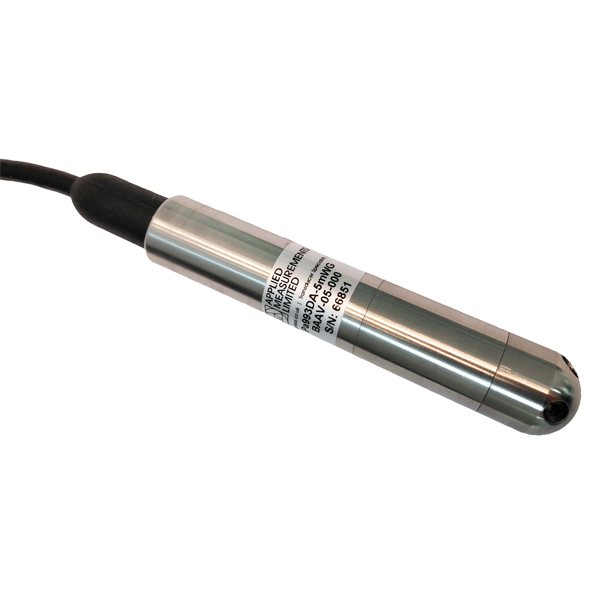
Applied Measurements’ P9911 series submersible depth sensor is available in ranges from 0-2 to 0-100 metres water gauge and provides an industry standard 4-20mA output. The all stainless steel sensor offers great flexibility, with its two piece body design providing ease of access to the zero and span potentiometers and 5 to 1 turn down switches, allowing full field adjustability.

The two halves of the unit are bolted together using six Allen screws and sealed by means of an ‘O’ ring.  This, together with an IP68 sealed polythene cable outlet, completes the high integrity waterproof assembly which maintains full sealing to a depth of 100 metres.

Both the sensor and electronics are protected against the effects of lightning strikes offering distinct advantages over competitive products.

The P9911 is fully temperature compensated and is ideal for long term bore hole monitoring.

Options include extended temperature ranges and alternative body materials for chemical and seawater applications.

For further information please contact Ollie Morcom on 0118 981 7339 or send an e-mail to info@appmeas.co.uk.

NOTE: March 2010 – The P9911 is no longer a current product so this article exists for reference only.  The P9911 has been replaced by our Pi9911 Re-Rangeable Depth Sensor.