Click any letter to view terms starting with that letter.
A – B – C – D – E – F – G – H – I – J – K – L – M – N – O – P – Q – R – S – T – U – V – W – X – Y – Z
A
Axial Load – The load applied to the length of, or parallel to, the primary axis with which it shares a common axis.
Ambient Conditions – The conditions (humidity, pressure, temperature, etc.) of the medium surrounding the load cell.
Angular Load Eccentric – A load applied eccentric with the primary axis at the point of application and at some angle with respect to the primary axis.
Angular Load Concentric – A load applied concentric with the Primary axis at the point of application and at some angle with respect to the Primary axis.
C
Calibration – Load cell output comparison against standard test loads.
Combined Error – The maximum deviation from the straight line drawn between original no-load and rated load outputs of a transducer output due to non-linearity (increasing load) and hysteresis (decreasing load). It is expressed as a percentage of the rated output.
Compensation – The utilization of supplementary devices, materials, or process to minimize known sources of error.
Creep – The output change of a load cell that occurs over time while it is under load, while all environmental conditions and other variables have remained constant.
Creep Recovery – The change in no-load output occurring with time after removal of a load which had been applied for a specific period of time. Usually measured over a specific time period immediately following removal of rated load and expressed as a percentage of rated output over a specific period of time.
D
Dead Volume – The volume inside the pressure port of a sensor, or transducer, at room temperature and barometric pressure.
Deflection – The change of length along the primary axis of the load cell involving no-load and rated-load conditions.
Diaphragm – The membrane part of a sensor that changes its value under pressure-induced displacement.
Drift – An unexpected change in output under constant load conditions.
Driveline Shaft – A steel tube with a u-joint at each end that transfers torque from the output of the transfer case to the axle.
E
Eccentric Load – A load which is applied parallel to, but not having a common axis with, the primary axis.
Electrical Excitation – The current or voltage that is applied to the input terminals of a transducer.
Error – The algebraic difference between the indicated and true value of the load being measured.
F
Flush Diaphragm – A sensing device that is located on the very end of a transducer with no pressure port.
Frequency Response – The range of frequencies over which the load cell output will follow the sinusoidally varying mechanical input within specified Limits.
Full Scale – The amount produced equivalent to the maximum load for a specific application or test.
Full Scale Output – The numerical distinction between the least output and the rated capacity.
H
Hysteresis – The greatest difference between load cell output readings for the same applied load. One reading is obtained by escalating the load from zero, the other by lessening the load from rated output.
I
Input Impedance – The resistance measured across the excitation terminals of a transducer at room temperature at the point where there is no load applied and the output terminals are open-circuited.
Insulation Resistance – The DC resistance measured between the load cell circuit and the load cell structure. Normally measured at fifty volts and under standard test conditions.
L
Load – The force, weight or torque that is applied to the transducer, cell or sensor.
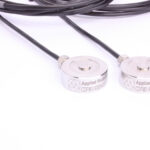
Load Cell – The round shape of the top surface of a load cell, transducer or load sensor where the load is applied.
M
Measured Media – The physical number, property or circumstance which is measured, such as acceleration, force, mass or torque.
N
Natural Frequency – The frequency of free oscillations under no-load load conditions.
Non-Linearity – The maximum deviation of the calibration curve from a straight line drawn between the no-load and rated outputs; expressed as a percentage of the rated output and measured on increasing load only.
O
Output – The signal (voltage, current, pressure, etc.) produced by the load cell. Where the output is directly proportional to excitation, the signal must be expressed in terms of volts per volt, per ampere, etc, of excitation.
P
Piezoresistance – The change in resistance caused by an applied strain of the diaphragm.
Primary Axis – The geometric centerline (axis) along which the load cell is designed to be loaded.
Pull Plate – An attachment to the load cell which allows tension or compression force to be directed at the center line of a load cell through a threaded center hole.
R
Rated Capacity (Rated Load) – The maximum axial load the load cell is designed to measure within its specifications.
Rated Output – The algebraic difference between the outputs at no-load an at rated load.
Reference Standard – A force measuring device whose characteristics are precisely known in relation to a primary standard.
Repeatability – The maximum difference between load cell output readings for repeated loadings under identical loading and environmental conditions.
Resolution – The smallest change in mechanical input which produces a change in the output signal.
S
Safe Overrange – The maximum pressure or load which may be applied to the transducer, load cell or sensor without causing permanent damage or a change in the performance specifications.
Sensitivity – The ratio of the change in output to the mechanical input.
Shear – Force that tends to divide an object along a plane parallel to the opposing stresses.
Shunt Calibration – Electrical simulation of load cell output by insertion of known shunt resistors between appropriate points within the circuitry.
Shunt-To-Load Correlation – The difference in output readings obtained through electrically simulated and actual applied loads.
Side Load – Any load acting 90 degrees to the primary axis at the point of axial oad application.
Stabilisation Period – The time required to insure that any further change in the parameter being measured is tolerable.
Standard Test Conditions – The environmental conditions under which measurements should be made when measurements under any other condition may result in disagreement between various observers at different times and places. These conditions are as follows: Temperature 23ºC ±2ºC (73.4 degrees ±3.6ºF).
Strain Measurement – The ratio of the change of the length of a structure when force is applied to it to the dimension of the original length.
T
Temperature Effect On Rated Output – The change in rated output due to a change in ambient temperature.
Temperature Range (Compensated) – The range of temperature over which the load cell is compensated to maintain rated output and zero balance within specific limits.
Temperature Range (Safe) – The extremes of temperature within which the load cell will operate within permanent adverse change to any of its performance characteristics.
Terminal Resistance Corner To Corner – The resistance of the load cell circuit measured at specific adjacent bridge terminals at standard temperature, with no load applied, and with the excitation and output terminals open-circuited.
Terminal Resistance Input – The resistance of the load cell circuit measured at the excitation terminals at standard temperature, with no load applied and with the output terminals open-circuited.
U
Ultimate Overload Rating – The maximum load in percent of rated capacity which can be applied without producing a structural failure.
Z
Zero Balance – The output signal rated excitation of a load cell with no load applied, usually expressed in percent of rated output.
Have an application you want to discuss? Let us call you…
Why Us?
- Suppliers of top quality strain gauge sensors and transducers to every corner of industry – UK and worldwide
- Over 100 years of expert transducer knowledge
- Our high quality products all come with a 3 year warranty